The theory of conscious balance
An economic and societal theory, nondenominational and nonpartisan, that treats balance as a living process—to be perceived, discerned, adjusted, and passed on, again and again.
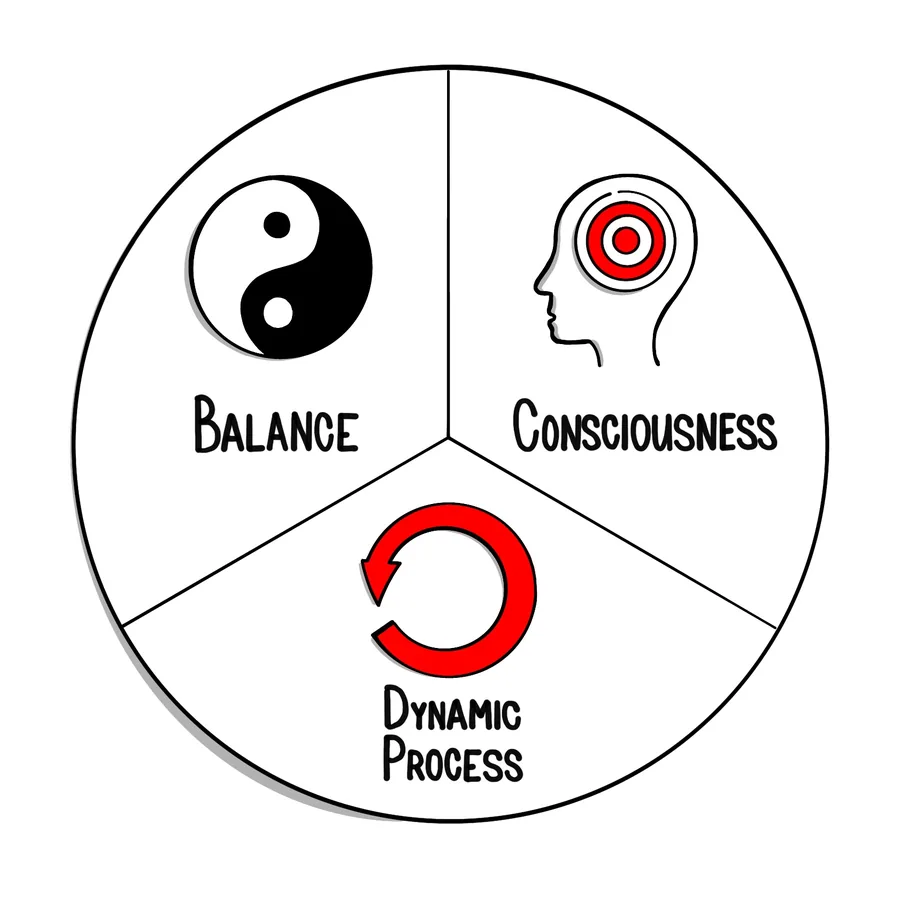
Equiconscism is an economic and societal theory of conscious balance. It conceives of balance not as a state to be reached but as a dynamic, continuous, and differentiated process through which people, organizations, and societies constantly adjust their decisions so that the economy, society, and the living world support one another—by consciously widening their gaze to all those, human and non-human, present and yet to come, whom these decisions touch.
David Fiorucci, Equiconscism, 2026, chapter 7.
Drawing: Lars Hoop
Three words, one intention
Balance
Not stillness, nor arithmetic equality, but the fruitful, regulated tension between complementary forces; it is maintained through movement—the pendulum, the spinning top, walking, the homeostasis of living beings.
Conscious
One who sees, who knows what they are doing and what their action produces, and who answers for it: self-awareness, awareness of others and of the world, moral conscience.
Dynamic process
A sequence of interactions and feedbacks in which each adjustment changes the context of the next. Conscious balance is never achieved once and for all.
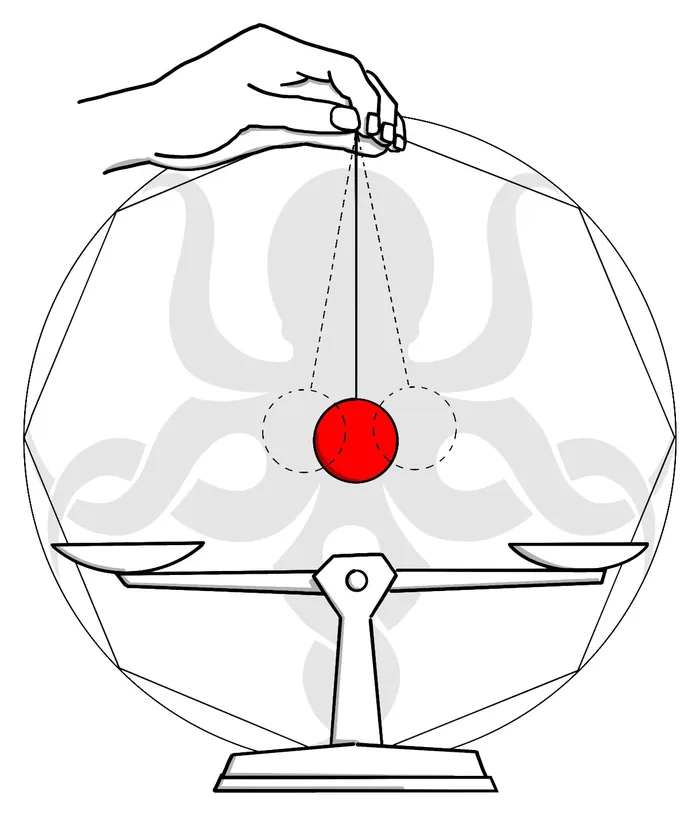
Etymology: Latin aequus (equal, fair, level—as in aequilibrium, from aequus and libra, the scales) + conscientia (“knowing with,” shared knowledge) + -ism. Literally: a thought and practice of just balance, enlightened by shared knowledge.
The economy, society, and the living world
Always together, never traded off against one another. Consciousness is the hand that links them.
A measured and shared economy
Value creation in the service of life: quality, durability, chosen sufficiency, fair sharing of value—capital as a means, not an end.
An inclusive society built on solidarity
Dignity, belonging, justice, participation, attention to differentiated needs, bonds between generations.
A respected and regenerated living world
Planetary boundaries, ecosystems, animals, common resources (water, air, soils, land)—regeneration rather than mere damage reduction.
The corridor of right measure
For each dimension there is a floor—below which dignity, essential needs, or viability are not ensured—and a ceiling—beyond which excess exhausts people, tears the social fabric, or overshoots the limits of the living world.
Conscious balance is the regulated swing inside this corridor. It extends Aristotle’s mean and Kate Raworth’s Doughnut dynamically, applies them at every level, and adds the consciousness that regulates.
A breached floor cannot be offset by a ceiling reached elsewhere.
Involved, affected, absent
Before deciding, identify who and what is involved, who is affected—directly or indirectly—and who is absent: future generations, non-human beings, vulnerable people, those far away.
Opening one’s eyes
Opening one’s arms
Opening one’s heart
Listening
Knowing when to be silent
The five gestures of widening the gaze. Differentiated equity follows: not everyone needs the same thing.
The cycle of conscious balance
The cycle says how to proceed. The seven principles say by what standard.
Open your eyes: see the situation, the forces at play, the parties involved and affected, the weak signals.
Open your arms and your heart, make room, fall silent: welcome every voice, including minority and absent ones.
Weigh (the scales): differentiated needs, floors and ceilings, short/medium/long term, the ten key questions.
Act with measure, correct the amplitude, decide by consent when the decision is collective.
Give an account (accountability), measure, learn, pass on; then the cycle begins again.
The seven principles of Equiconscism
Movement rather than state
Balance is a process, never something won once and for all.
Right measure rather than the maximum
Optimize within the corridor; do not maximize a single variable.
Differentiated equity rather than uniformity
To each according to their needs and capacities, in shared dignity.
Widening the gaze
See those involved, those affected, and those absent; human and non-human; today and tomorrow.
Linking the levels
From the person to the planet: subsidiarity and solidarity.
Regeneration rather than mere preservation
Leave people, relationships, and the living world in better shape.
Embraced responsibility
Give an account (accountability), and recognize joy and vitality as signs of rightness.
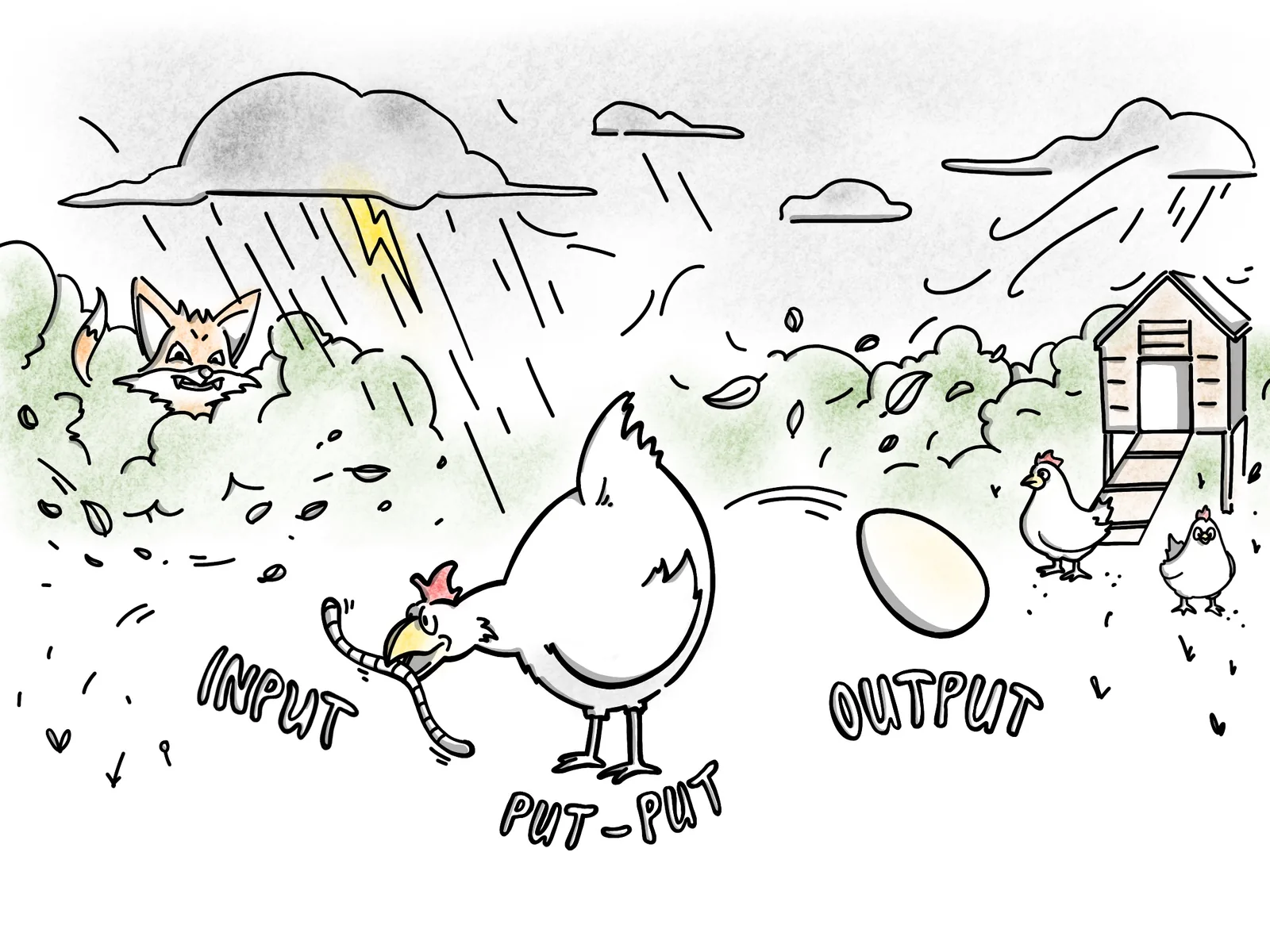
Illustration: Lars Hoop
Input – Put-Put – Output
Every activity transforms resources (input: the worm, food, energy, work, attention) through a living process (put-put: the hen’s clucking, the patient, invisible work that takes its time) into a result (output: the egg, which nourishes and carries the next life)—in a storm (the polycrisis), under the eye of the fox (predators, risks, temptations to exploit), with a henhouse and a community.
Conscious balance looks at the whole process, not only at the output.
What Equiconscism is not
Not a partisan ideology
It speaks to the right, the left, and the center: the floors of dignity and the ceilings of the living world concern everyone.
Not a religion
Nondenominational, it dialogues with the world’s wisdom traditions without asking anyone to give up their faith—or their absence of faith.
Not a lukewarm middle ground
Not the “soft center”: right measure can demand courage, and floors and ceilings are not negotiable.
Neither blind growth…
…which maximizes a single variable at the expense of all others.
…nor punitive degrowth
Measure is not scarcity: “measured” does not mean “small.”
Not a utopia
It starts where you are, with small, verifiable steps, at the micro and meso levels.
Join the conversation
Your perspective enriches the theory. Comments are moderated before publication; please stay respectful and constructive.
The discussion is provided by Cusdis, a privacy-friendly service without advertising or tracking. It is loaded only when you click below. Privacy